Guide // Your website
Music website hosting: who should own your domain?
Music website hosting custom domain guide: keep control of your band's address, check registrar access, and change website builders without losing control.
Dean Rud, Meter Records
Playing in bands since 1996. Running a record label since 1998.
Updated Nov 25, 2026

You or your band’s agreed business entity should be the registrant of your domain, with direct access to the registrar account. Your website builder can host the site and help connect the address, but a manager, designer or former bandmate should not be the only person who can renew it, change its settings or recover the account.
TL;DR
- For music website hosting custom domain decisions, keep domain control separate from whoever builds or maintains your site.
- Bandweb suits independent musicians who want releases and tour dates to sync without repeated website edits.
- Keep registrar access, renewal notices and recovery details under your control.
- Changing website hosting does not necessarily require transferring your domain registration.
Music website hosting: who should own your domain?
The artist or the band’s agreed business entity should hold the domain registration. Someone else can manage the technical work without becoming the only person who controls the address.
That distinction matters whether you build pages yourself or use an auto-updating musician website builder such as Bandweb. Updating releases and controlling your domain are separate jobs. Keep them separate in your accounts, too.
| Registration arrangement | Best for | Main advantage | Main drawback |
|---|---|---|---|
| Artist-controlled account | Solo musicians managing their own website | You control renewal, recovery and changes | You must maintain account security and contact details |
| Band business-controlled account | Bands with an agreed business structure | Control stays with the agreed entity | Members need clear access and departure rules |
| Manager-controlled account | Delegating administration | Less day-to-day account work for the artist | You depend on the manager unless you retain access and document control |
| Designer-controlled account | Delegating website setup | The designer can handle the initial configuration | A website handover is incomplete without domain access |
Delegate the work, not your only route back into the account. A friendly working relationship is not a substitute for recoverable access.
Why this matters
Your domain can appear on release artwork, posters, press kits and social profiles. The website behind it can change. The address should remain under your control.
For your 2026 website setup, treat that address as a continuing part of the project, not an accessory bundled with a page design. If the person who built the site leaves, you still need to receive renewal notices and decide where the address points.
Domain control also affects more than the homepage. If you use an email address at your domain, changes to its DNS settings can affect email delivery. A rushed website move should not break the inbox where promoters send enquiries.
The practical goal is simple: you can replace your website provider without first negotiating access to your own address. That is a useful test of any setup, regardless of which builder you choose.
How do you keep control of your music website domain?
Use this sequence before launch. If the site is already live, work through the same steps as an account check rather than starting over.
1. Name the registrant
Decide whether the registrant will be you personally or your band’s business entity. Use accurate details and follow the registrar’s requirements.
For a band, write down who controls the domain and what happens if members leave. Do not leave that decision buried in an old group chat. Registration details and an agreement between bandmates serve different purposes; neither replaces the other.
2. Secure account access
Use a registrar account you can access directly. Enable multi-factor authentication where supported, keep recovery codes securely and use delegated access for helpers where the registrar offers it.
Avoid making an outside collaborator’s personal email address the only recovery route. Also avoid making an inbox on the domain itself your only recovery address: trouble with the domain can then complicate account recovery.
3. Check renewals
Confirm who receives renewal notices, which payment method is attached and when the registration expires. If you enable automatic renewal, keep the payment details current rather than assuming the setting solves everything.
Add the expiry date to your 2026 admin calendar. The important part is not the calendar app. It is having someone clearly responsible for checking that the domain remains registered.
4. Save DNS records
Before connecting a different host, save the existing DNS configuration. Identify which records serve the website and which support email or other services.
Ask the new host which records actually need changing. Replacing the entire configuration without checking it is a different operation from updating the website destination.
5. Test the handover
Confirm that you can sign in, find the domain settings, inspect renewal details and reach the recovery options. Receiving a password in a message is not the same as confirming that access works.
If someone built the site for you, complete this check before closing the project. A finished design does not prove that the domain account has been handed over.
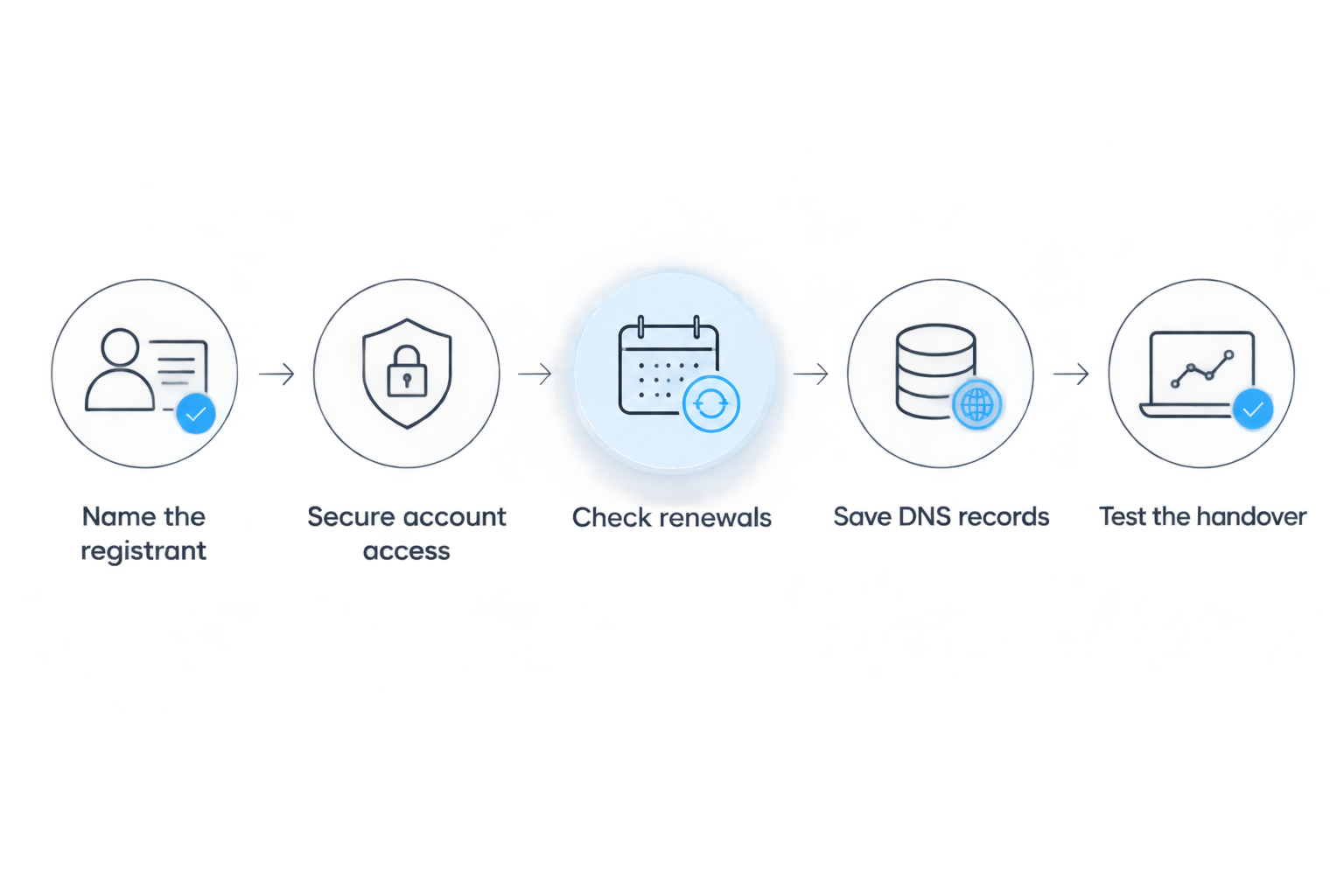
Complete the account handover, not just the website design.
Why domain control varies between website setups
Two musicians can use the same website builder and have very different levels of control over their domains. The difference sits in the account arrangements, not the appearance of the site.
Check these factors during your 2026 hosting review:
- Registrant details: The registration should identify the intended holder, not simply whoever completed checkout.
- Account access: Direct access lets you act without waiting for a manager or designer to reply.
- Recovery details: An accessible recovery address and supported security methods help you retain access when circumstances change.
- Renewal responsibility: Someone must maintain payment details and watch for registrar notices.
- DNS administration: Know who can change the website destination and who understands any email records.
- Handover agreement: Define what happens when a working relationship ends, including access and outstanding administrative tasks.
None of these checks requires you to become a web developer. You need to know where the controls are and who can use them. Keep that information somewhere your band can find without searching through years of messages.
Does your domain registrar have to host your music website?
No. Your domain registrar and website host can be different providers. Domain registration maintains the address; website hosting serves the pages visitors see.
DNS connects the address to the services you use. Your host supplies connection instructions, and you or an authorised administrator applies the relevant settings.
Keeping registration and hosting together reduces the number of accounts you manage. Keeping them separate gives each service its own account and renewal process. Neither arrangement removes the need to check registrant details and recovery access.
When comparing music website hosting custom domain options, ask what happens if you leave. Can you change the destination yourself? Where are renewal settings? Does the provider distinguish connecting an existing domain from transferring its registration?
Those answers tell you more about control than a polished template gallery. Choose the arrangement you can maintain, and record how it works.
Should you transfer your domain when changing website builders?
Changing website builders does not necessarily require a domain transfer. You can often leave the registration with the existing registrar and update the DNS records that connect the address to your website.
A transfer changes which registrar manages the registration. A DNS change alters where a service points. They solve different problems, so ask which operation is required before authorising either.
For a 2026 website move, check the domain’s status and the registrar’s transfer requirements before scheduling the handover. Transfer eligibility and procedures depend on the domain and applicable rules; your new page design does not determine them.
Keep the existing website service active until the replacement is connected and checked. Test the main address, release links, press-kit links and any domain-based email you use. Cancel services only after you understand what each cancellation affects.
Also inspect important page addresses. Keeping the domain does not automatically preserve every old page path. If your platform supports redirects, plan them for pages you have already shared publicly.
What should you check before choosing a musician website builder?
Start with the job you want to stop doing. If your problem is re-entering release information and show dates, assess the update workflow. If your problem is domain access, fix the registration arrangements first.
Bandweb is best for independent musicians who want a no-code website with auto-synced releases and tour dates. Its stated scope also includes syncing merch and press kits from Spotify, Bandcamp, Bandsintown and other platforms.
The benefit is less repeated website upkeep. The trade-off is that automation and domain administration remain separate responsibilities: synced content does not remove your need to maintain registration access, renewals and recovery details.
Before starting a trial, check these points against your actual music setup:
- Which platforms hold the releases, dates and other material you want to display?
- Which of those sources does the builder support for the content you need?
- How do you connect an existing custom domain on the plan you are considering?
- What must you still maintain yourself?
- What happens to the domain connection if you later change providers?
Use a real release and your actual show information when evaluating the workflow. A sample page proves less than seeing whether your own material fits.
Try your actual music setup
Explore Bandweb’s auto-sync approach for releases, tour dates, merch and press kits.
Should your manager or web designer register the domain?
Your manager or designer can handle registration, but the intended registrant and account arrangements should be agreed before they begin. Paying someone to build a website does not answer who will control its address.
Give the collaborator the access needed for the task, using the registrar’s delegated-access features where available. Keep a direct recovery route under your control. If the provider does not offer separate permissions, decide how access will be managed and changed after handover.
For an existing arrangement, ask for the registrar name, domain expiry date, registrant details and a working access method. Then verify them. There is no need to move a functioning site simply because you are correcting its account administration.
FAQ
Who should own a band's website domain?
The band’s agreed business entity or designated registrant should hold the registration. Document control, access and what happens when members leave rather than relying on an informal understanding.
Can I keep my domain if I change music website hosting?
You can generally keep your domain when changing website hosting. Keep the registration active, retain account access and follow the new host’s connection instructions.
Do I need to transfer my domain to my website builder?
A registrar transfer is not inherently required to change website builders. Check whether the builder supports connecting your existing domain through DNS changes and what its requirements are.
Can my manager handle domain renewals for me?
Your manager can administer renewals, but you should retain access and a recovery route. Agree who checks notices and maintains payment details.
Will changing my music website affect my email address?
Changing website hosting does not automatically require changing your email service. Preserve the DNS records your email provider needs and test email after making changes.
Is a custom domain enough to keep my old release links working?
Keeping a custom domain does not automatically preserve old page paths. Check previously shared release and press-kit addresses, and configure redirects where your platform supports them.
Does an auto-updating website remove domain maintenance?
An auto-updating website does not remove domain maintenance. You still need to manage registration, renewal details, account security and access when collaborators change.
One last thing
A domain can open your website successfully even when you cannot access the account that controls it. Seeing the homepage load is not an ownership check.
Make your final 2026 check an account check: sign in, inspect the registrant details, confirm the recovery address and find the renewal settings. Then save the handover information securely. You want the next release announcement to involve sharing a link, not tracking down whoever registered it.
Related guides
Was this guide useful?
Next guide // 12
Musician website templates for solo artists: music, shows and contact →
Choose musician website templates for solo artists that put music, shows and contact first. Compare update workflows and avoid unnecessary manual upkeep.