Guide // Press and booking
How to make an EPK bookers actually read
What an EPK is, the nine parts bookers and press look for, how long each one should be, and how to send it. With an example, a free template and a checklist.
Dean Rud, Meter Records
Playing in bands since 1996. Running a record label since 1998.
Updated Nov 15, 2026
The short version
An EPK (electronic press kit) is a one-page website that tells a booker, journalist or label who you are, what you sound like, how you are live and how to reach you. Put your best song and a live clip at the top, keep the booking contact in plain sight, and send it as a link, not a PDF.
What is an EPK?
An EPK, short for electronic press kit, is a musician’s résumé for the music industry. It is one page with your music, bio, photos, live video, press quotes, shows and contact details. Music industry professionals, from talent buyers and festival bookers to journalists, playlist curators, labels and music supervisors, use it to decide quickly whether to book you, write about you, sign you or license your song.
It replaced the folder bands used to mail out: a glossy photo, a bio, a few clippings and a CD. Today it is a link. A link opens on a phone, plays without a download, and can change after you send it.
An EPK is not your whole website. Your site talks to fans, with merch, a mailing list and the full story. The EPK talks to the people who decide on you, and they give it a minute or two. Most artists keep it on their own site at an address like yourname.com/epk.
What goes in an EPK
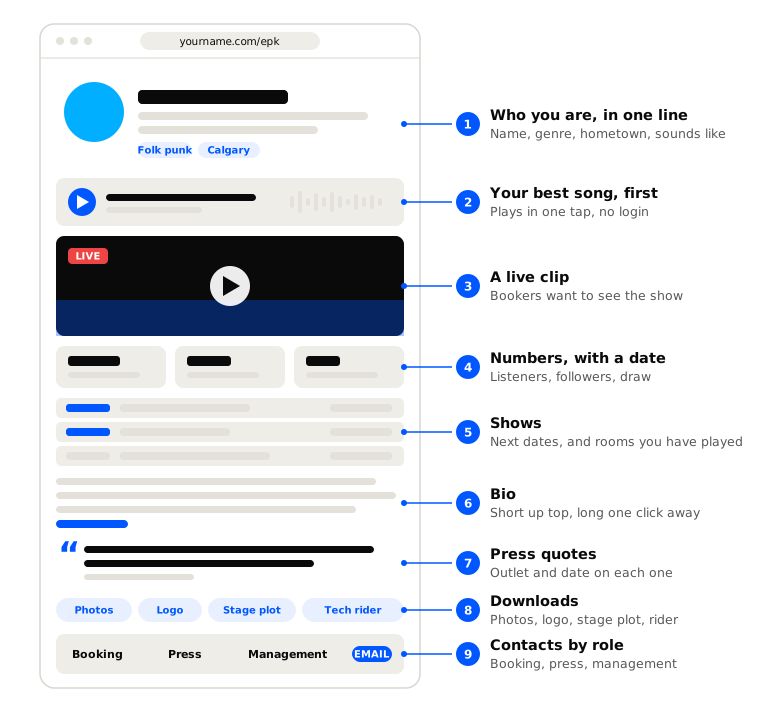
Nine parts, plus documents if you play live. Keep them in this order, so the music and the live clip come before anything a booker has to read.
| # | Part | What to include | How much |
|---|---|---|---|
| 1 | One-line pitch | Name, genre, hometown, two or three artists you sound like | Under 25 words |
| 2 | Music | Your best tracks, strongest first, playable in one tap | 3 to 5 tracks |
| 3 | Live video | Unedited clips from real shows | 1 or 2 clips |
| 4 | Numbers | Listeners, followers, mailing list or draw, each with a date | 2 to 4 numbers |
| 5 | Shows | Upcoming dates, plus notable rooms and festivals you have played | Next dates, and the last year or two |
| 6 | Bio | A short bio and a long bio, in the third person | 50 to 100 words, and 300 to 500 words |
| 7 | Press | Quotes with the outlet, the date and a link to the full piece | 2 or 3 quotes |
| 8 | Photos and logo | Press photos in landscape and portrait, plus your logo | 3 to 5 photos, 1 logo |
| 9 | Contacts | Booking, press and management, each with an email | One per role |
| + | Documents | Stage plot, input list, tech rider, hospitality rider (live acts) | One PDF each, with the date it was updated |
Music: your best song goes first
A booker decides whether you fit the room from the first track. Put the one song you would play them if they only heard one at the top, then two to four more. Link to Spotify, Apple Music, Bandcamp or YouTube so each one plays in one tap.
Use public streaming links. Skip private links that ask for a login, Dropbox folders of WAV files and anything that autoplays when the page opens. Each of those costs you the listen.
Live video: show them the show
For anyone booking live music, this is the part that matters most. Barnett English, who books Joshua Tree Music Festival, told Pirate.com he looks for two or three unedited videos of a band playing live, and that a slick music video does not help if he has never seen them on a stage. One clean clip from a real night does more than a sizzle reel.
Pick a clip with good sound, a visible crowd if you have one, and a song from the first few tracks on your list.
Numbers: real, current and dated
Bookers use numbers to guess who will buy a ticket. Pick the two to four that say the most about you: monthly listeners, followers on your strongest platform, the size of your mailing list, or how many people came to your last headline show in a city.
Put an “as of” date beside them. Round down, never up. A booker who sees 40 people at your show after you claimed 300 will remember the 300.
Shows: upcoming dates and where you’ve played
List the next dates with the city and the venue. Then keep a short list of past shows that prove something: a sold-out room, a festival slot, a support slot for a known act, or a run of shows in the booker’s region. Festival bookers say regional history is one of the first things they check.
Artist bio: three lengths, written once
Write the long bio first, then cut it down. Use the third person, and be specific: where you are from, what you sound like, and the one or two things that have happened. Writers quote concrete details, like the town, the room you recorded in, or the tour that went sideways. Leave out “passionate about music”.
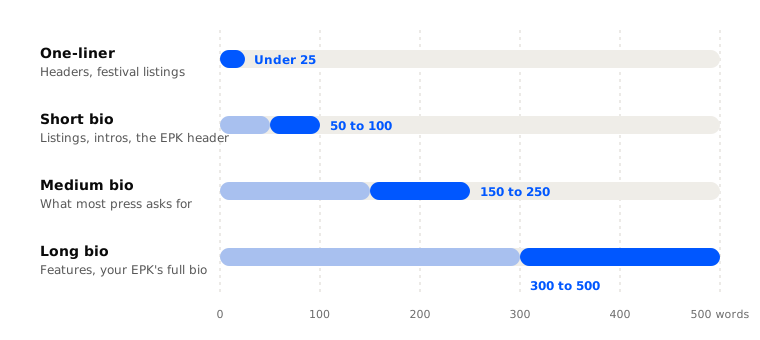
The musician bio guide walks through writing each one.
Press quotes
Two or three short quotes beat a wall of ten. Give each one the outlet name, the date and a link to the full piece. Pick a line about the music, not one about the weather at the show.
Never invent or stretch a quote. Bookers and editors check, and a quote nobody can find costs more than having none.
Photos and logo
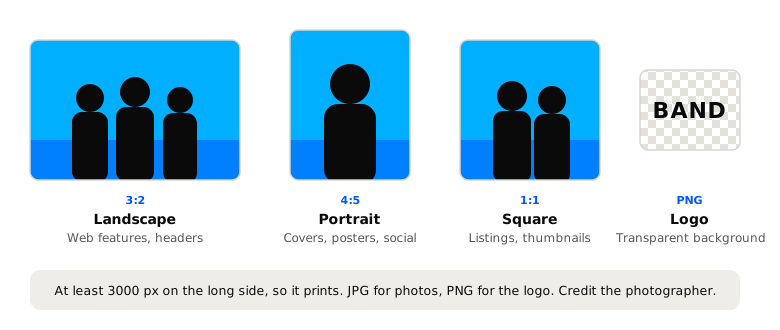
Journalists and promoters need photos they can run without emailing you first. Give them 3 to 5, in landscape and portrait, at print size, with the photographer credited. Add your logo as a PNG with a transparent background, and your current album artwork, for posters and listings.
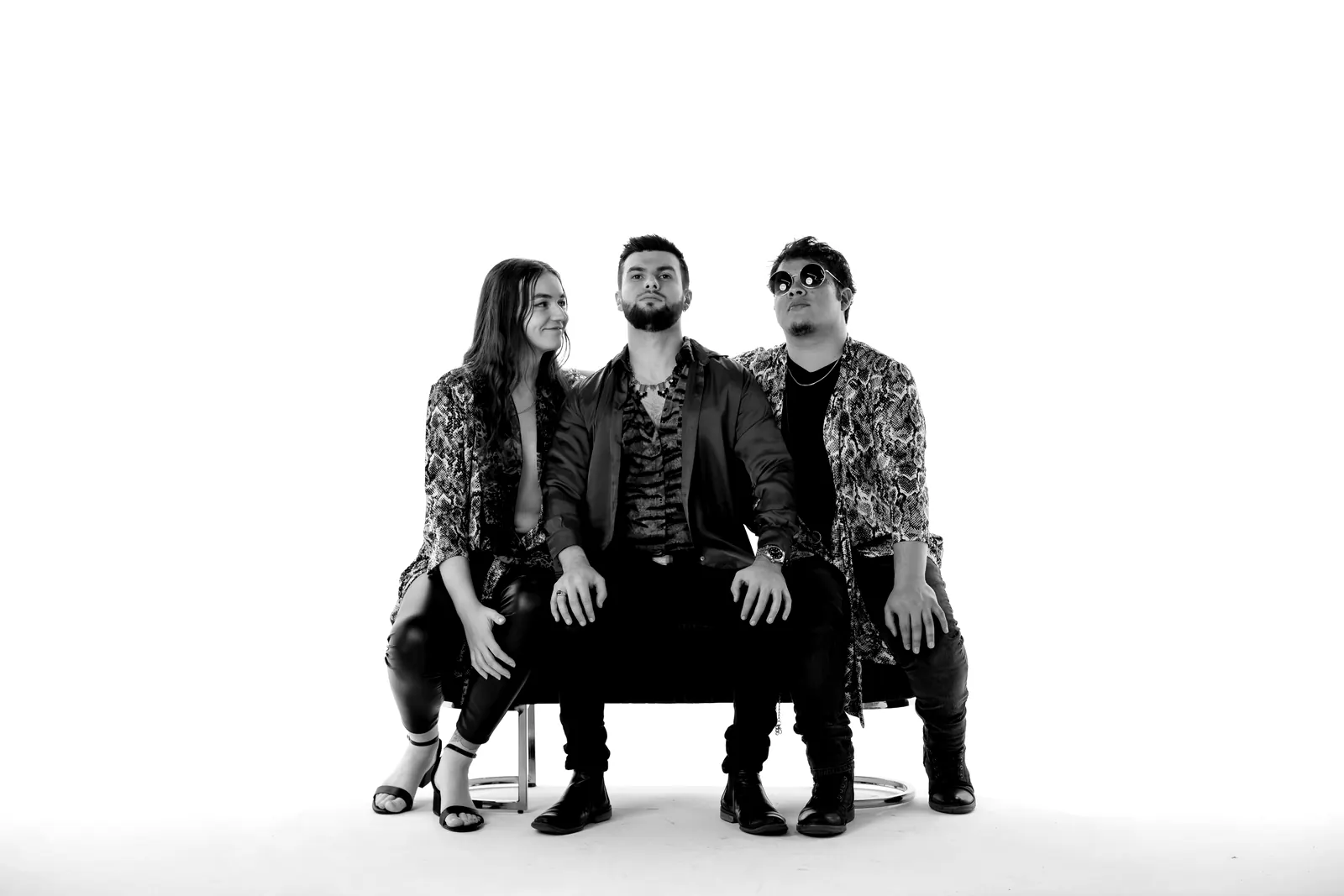 3:2 landscape
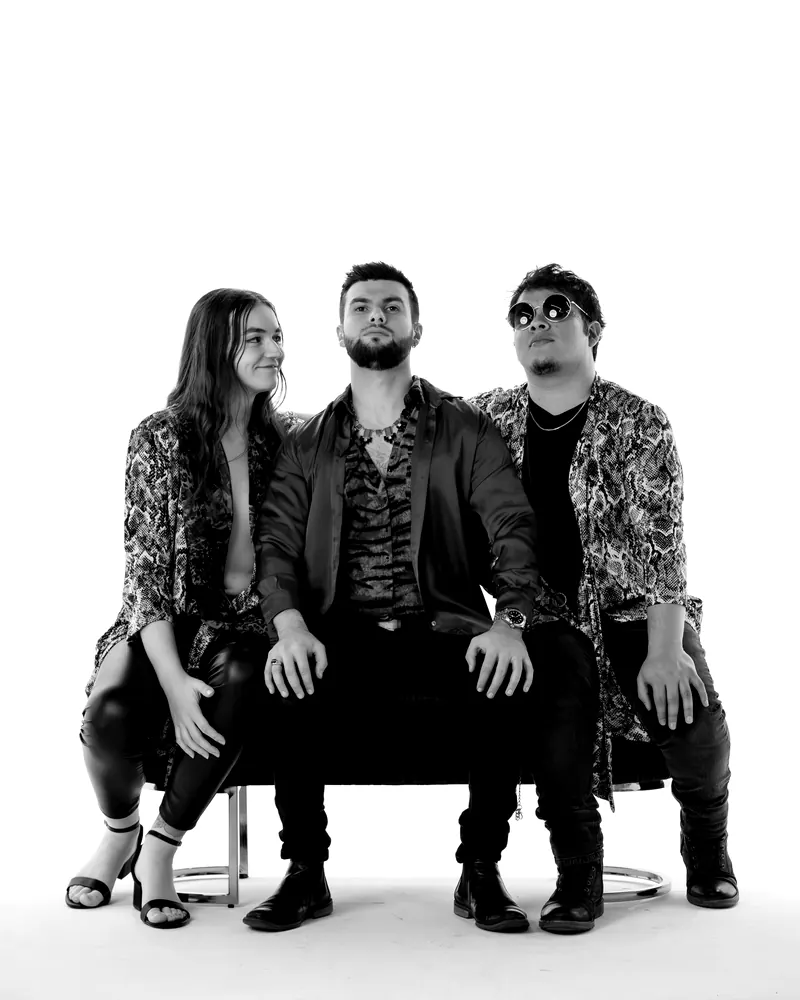 4:5 portrait
Contact information, by role
Put one booking email where it can be seen without scrolling to the footer, and not only behind a form. If you have a manager, a publicist or a sync rep, list each one with what they handle. The person reading should find the right inbox in seconds. Finish with streaming links and your main social media profiles, so they can check your numbers for themselves.
Documents for live acts
The stage plot, input list, tech rider and hospitality rider. Nobody reads these on the first pass. The production manager pulls them weeks later, when the show is being advanced. Keep the latest version on the page with the date it was updated, so nobody prints last year’s stage plot.
If you are a DJ
Swap tracks for two or three mixes on SoundCloud, Mixcloud or YouTube. List residencies and clubs alongside tours. Put your setup in the tech rider, including the decks and mixer you play on and whether you need a booth monitor. Promo photos still need both orientations.
How to make an EPK, step by step
1. Decide who it is for
Most EPKs serve bookers first, which is why the live clip sits so high. If you mostly pitch press for a release, or labels, lead with the story and the release instead.
2. Choose your music and a live clip
Pick 3 to 5 tracks and put the strongest first. Add 1 or 2 unedited live clips.
3. Write a one-line pitch and your bios
The one-liner: name, genre, hometown, and two or three artists you sound like, in under 25 words. Then the short bio and the long one.
4. Gather press photos and a logo
3 to 5 photos, both orientations, at least 3000 px on the long side, credited. One PNG logo.
5. Add numbers and shows, with dates
Two to four numbers with an “as of” date. Upcoming shows, then a few past ones that prove something.
6. Collect press quotes
Two or three, each with the outlet, the date and a link.
7. Add contacts and documents
A contact for each role. If you play live, the stage plot, input list and riders as PDFs, each dated.
8. Put it on one page at your own address
There are three ways to host an EPK:
- A page on your own website, at an address like yourname.com/epk. It looks settled, and the link never has to change.
- An EPK builder. Free and paid ones exist. Free plans usually put your kit on the builder’s address with its badge.
- A PDF. Useful as a backup for festival portals that only take uploads. Not as your main kit, because it cannot change after you send it.
Bandweb builds your website and your EPK from your artist name, at yourname.com/epk. See the EPK builder.
9. Test it on a phone
Open it on your phone, on cellular data. Every song should play, the video should load, nothing should ask for a login or autoplay, and the photos should download. Then hand your phone to a friend who has never seen it and ask them to find your booking email.
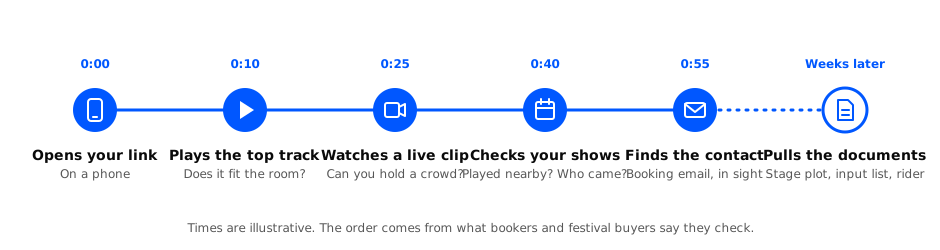
10. Send it, then keep it current
Paste the link into a short email, and update the kit at least once a quarter.
Who reads your EPK, and what they check first
The same page gets read by very different people. Here is what each one is looking for.
| Reader | Checks first | Lead with |
|---|---|---|
| Talent buyers and venues | Will people buy tickets? | Live clip, shows in their area, draw, booking contact |
| Festival bookers | Can you hold a crowd here? | Two or three live clips, regional show history, current numbers |
| Journalists and bloggers | Is there a story, and can I run these photos? | The release story, medium bio, photos in both orientations, quotes |
| Playlist curators and radio | Does the song fit? | The track, release date, genre, one line about the song |
| Labels and A&R | Is it growing, and who is on the team? | Dated numbers, release history, manager and agent, recent press |
| Music supervisors | Can I clear it fast? | Who controls the master and publishing, instrumentals, sync contact |
| Managers and agents sending it | Can I forward this without fixing it? | One current link, nothing out of date |
Managers and booking agents forward EPKs on an artist’s behalf all day. The quickest way to lose their goodwill is to make them fix your kit before it goes out: an old photo, last year’s tour, a dead link. They want one current link per artist.
How to send an EPK
Paste the link into the body of the email. Do not attach a PDF unless they ask for one. Keep it to four or five lines: who you are, why this show or outlet, the link, and what you are asking for.
Subject: [Artist] for [venue and date, or outlet]: [genre] from [city]

Hi [first name],

I'm [name] from [artist], a [genre] act from [city]. [One line of proof:
we drew 180 at [venue] in March, or the new single is out May 2.]

I'd love to [play your Friday room in June / be considered for your
new release roundup].

Music, live video and contacts: yourname.com/epk

Thanks,
[name] · [phone]
Follow up once, about a week later, with one new fact, such as a new date or a new quote. If a festival portal only takes uploads, export a PDF and put the date in the file name.
EPK, one sheet or PDF?
| Format | Best for | Watch out for |
|---|---|---|
| EPK (web page) | Ongoing pitching to bookers, press and labels | It needs to stay current |
| One sheet | One release, sent to press, radio and retail | Out of date when the next release lands |
| PDF press kit | Festival portals and forms that only take uploads | It cannot change after you send it, and it is heavy on a phone |
More on the release version: how to make a music one sheet.
Mistakes that end the read
- A link that asks for a login, or a shared folder of files
- Music that starts playing on its own
- Last year’s tour still listed as upcoming
- Numbers with no date, or rounded up
- A press quote nobody can find
- The booking contact buried in the footer or behind a form
- One photo, cropped wrong for every use
- A PDF as the only version
- Links that go nowhere
Keep it current
Update the EPK at least once a quarter, and whenever something changes: a release, a run of shows, a new quote, better photos. An EPK with a finished tour still on it tells a booker you have gone quiet. A calendar reminder in the first week of each quarter is enough.
If your EPK lives on Bandweb, new releases, videos and upcoming shows come in every day from the platforms you connect, on a paid plan. Press quotes, photos and documents stay as you left them until you change them.
EPK example
Ghost Factory
Folk punk · Calgary
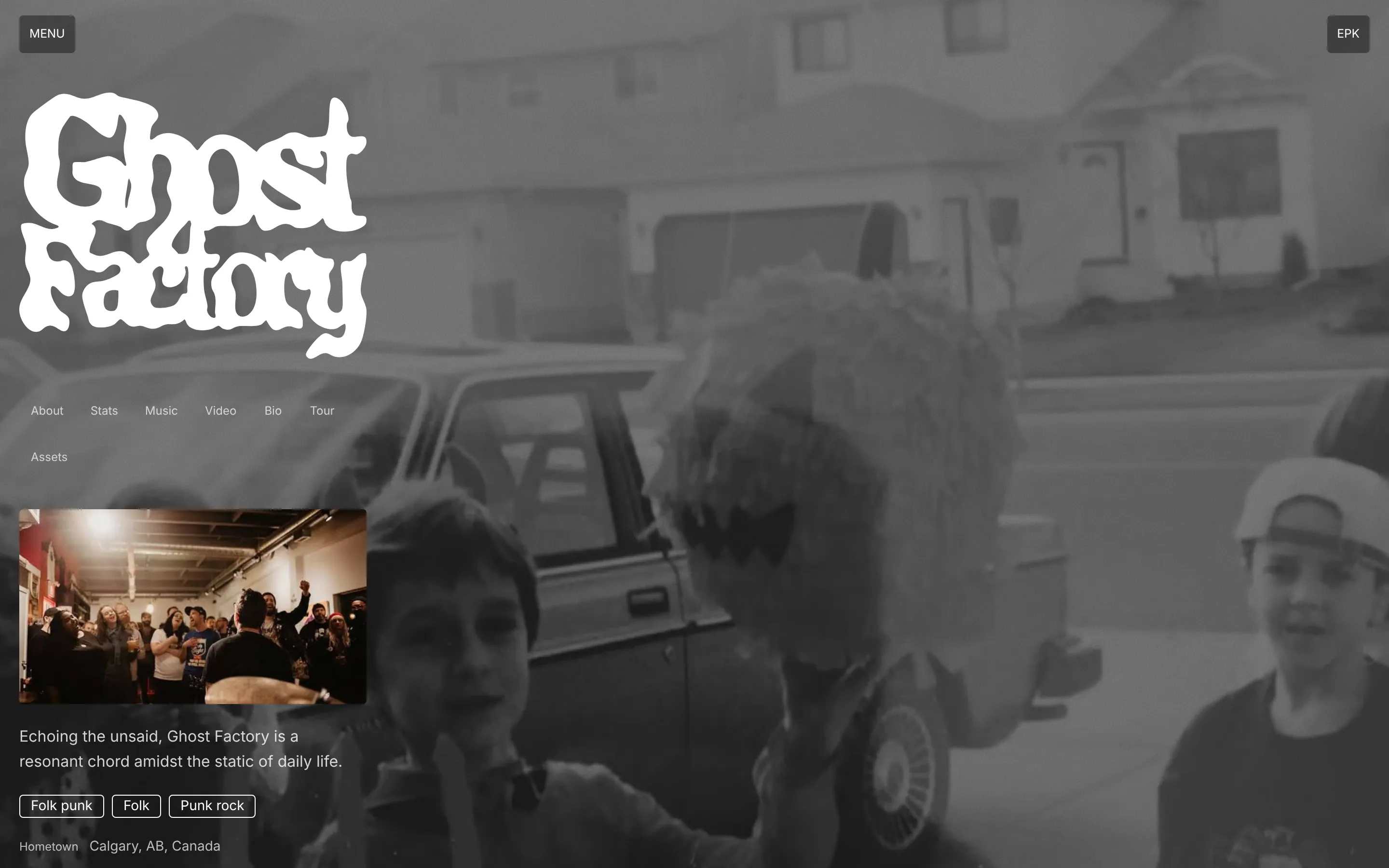
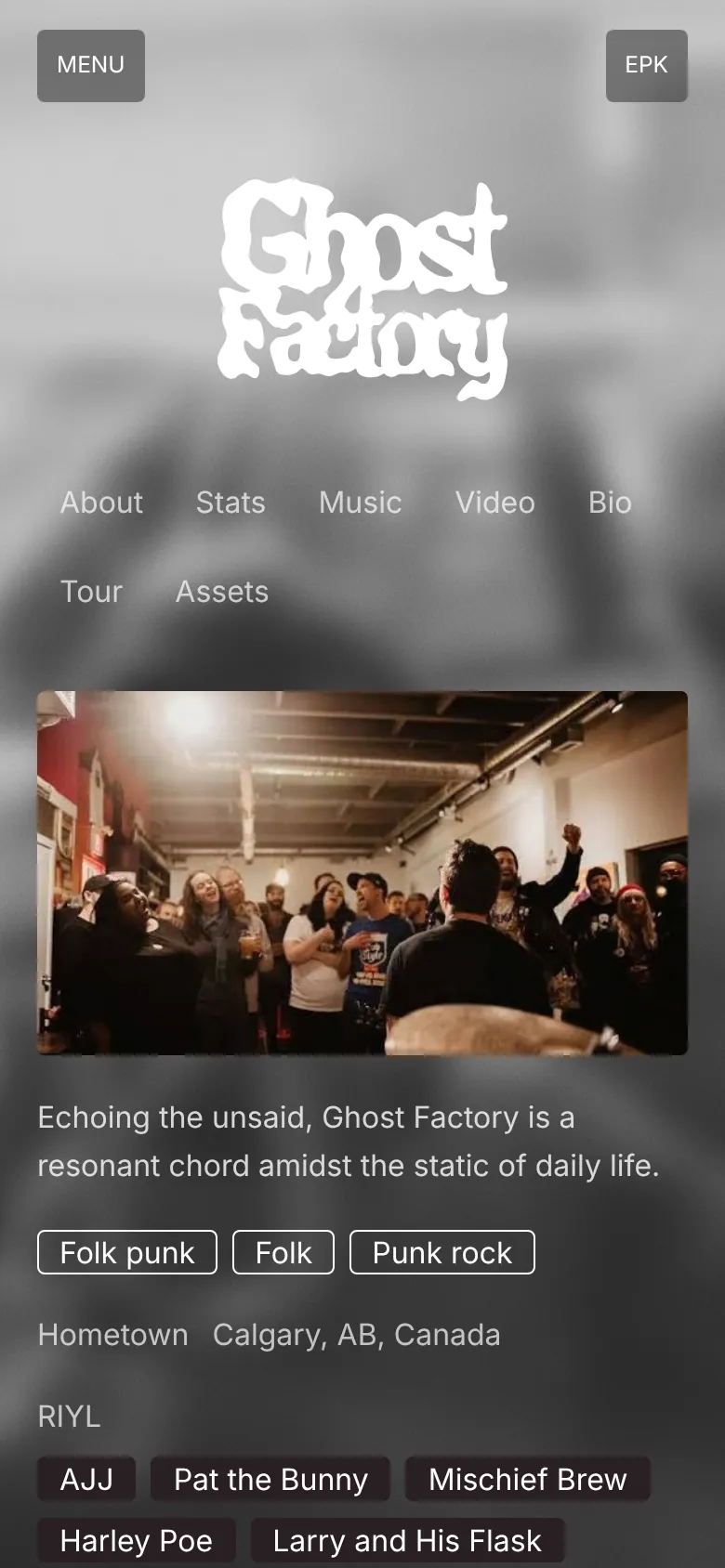
Built on Bandweb. Notice the sounds-like artists in the header, the music before the bio, and the full bio one click away.
Open the EPKFree EPK template
If you would rather start from a blank page, the free EPK template lists every part with word counts and prompts. Copy it into a doc, fill it in, then move each part onto your site or builder.
Questions people ask
Was this guide useful?
Next guide // 02
EPK template →
A free electronic press kit template with every section, word counts and prompts. Copy it into Google Docs, Canva or your website, fill it in, and send one link.